Latar Belakang
Seperti yang Anda ketahui, "Kemalasan adalah mesin kemajuan." Dalam pekerjaan saya, saya pernah menghadapi masalah ketika perlu membuat tabel untuk menghitung bunga pada perjanjian pinjaman, di mana jumlah hari sebenarnya dalam setahun seharusnya menjadi basis. Ketidaknyamanannya adalah Anda tidak boleh melupakan tahun kabisat dan memisahkan hari-hari yang termasuk tahun kabisat dan hari-hari tahun bukan kabisat. Sebuah rumus sederhana telah ditulis, tetapi kemudian saya menemukan bahwa menghitung tahun kabisat tidaklah sesederhana itu.
Deskripsi masalah
Saya ingin meningkatkan formula. Di Internet, saya menemukan banyak teks program di mana jumlah tahun dan hari kabisat atau bukan kabisat dalam suatu periode dihitung. Namun, sayangnya, saya tidak puas dengan fakta bahwa kecepatan fungsi-fungsi ini bergantung pada jumlah tahun periode tersebut. Dan saya ingin fungsinya bekerja dengan cepat, tidak peduli berapa tahun dalam periode tersebut. Tetapi selama pengembangan, saya harus membatasi periode yang diizinkan dari fungsi tersebut.
Alasan 1
Sebagian besar negara hidup menurut kalender Gregorian, aturan tahun kabisat yang ditentukan pada tahun 1582 oleh Paus Gregorius XIII :
1. Tahun yang jumlahnya habis dibagi 400 adalah tahun kabisat;
2. Sisa tahun, yang jumlahnya merupakan kelipatan 100, adalah tahun bukan kabisat (misalnya, tahun 1700, 1800, 1900, 2100, 2200,2300)
3. , 4, - .
2900, 3200, 4000, 01.01.2900.
2
Excel VBA (Visual Basic for Applications). , MS Office, .
Excel , 1900 1904. 1900. , 1 01 1900 , 2 – 2 .
VBA CDate(expression), Date . 1, Date 31 1899 . 60 CDate 28.02.1900, 29.02.1900 (, , 1900 ). , 01 1900 .
Excel, Microsoft , . 01 1900 .
, () , .
, 4, 4 () 1 . 1- 1 4, 2- 5 8 .
1 4 (, 2021 506- , 1)
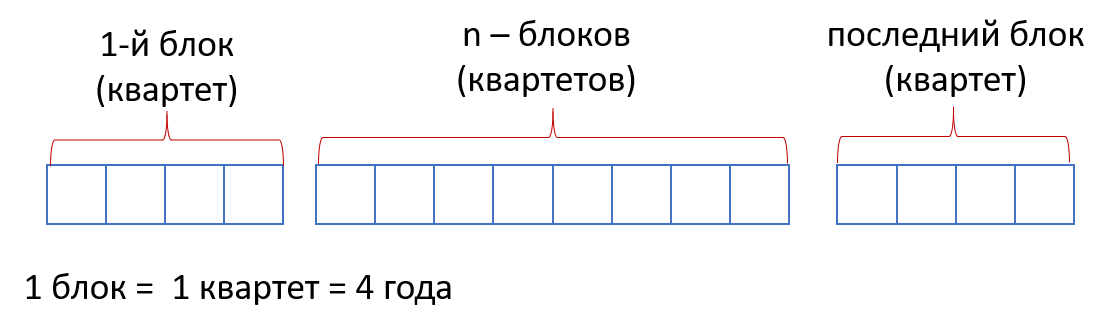
3 :

:
:

, , :

, , :

, , , 1- 366 ( 1 3, ).
VBA:
Private Function first_quartet_leap_year_days(ByVal d_begin As Date, ByVal d_end As Date) As Long
Dim result As Long
result = 0
Dim year_diff As Long
Dim quartet_index_diff As Long
year_diff = year(d_end) - year(d_begin)
quartet_index_diff = quartet_index(year(d_end)) - quartet_index(year(d_begin))
If year_diff = 0 And is_year_leap(d_begin) Then
result = DateDiff("d", d_begin, d_end)
first_quartet_leap_year_days = result
Exit Function
End If
If quartet_index_diff = 0 Then
If is_year_leap(d_begin) Then
result = DateDiff("d", d_begin, CDate(DateSerial(year(d_begin), 12, 31)))
first_quartet_leap_year_days = result
Exit Function
End If
If is_year_leap(d_end) Then
result = DateDiff("d", CDate(DateSerial(year(d_end) - 1, 12, 31)), d_end)
first_quartet_leap_year_days = result
Exit Function
End If
Else
If is_year_leap(d_begin) Then
result = DateDiff("d", d_begin, CDate(DateSerial(year(d_begin), 12, 31)))
first_quartet_leap_year_days = result
Exit Function
Else
If Not is_quartet_noleap(quartet_index(year(d_begin))) Then
result = 366
first_quartet_leap_year_days = result
Exit Function
End If
End If
End If
first_quartet_leap_year_days = result
End Function
>0, 3- " ".
, , :

Private Function last_quartet_leap_year_days(ByVal d_begin As Date, ByVal d_end As Date) As Long
Dim result As Long
result = 0
Dim quartet_index_diff As Long
quartet_index_diff = quartet_index(year(d_end)) - quartet_index(year(d_begin))
If quartet_index_diff > 0 Then
If is_year_leap(d_end) Then
result = DateDiff("d", CDate(DateSerial(year(d_end) - 1, 12, 31)), d_end)
End If
End If
last_quartet_leap_year_days = result
End Function
>1, 2- " ".

– . 1999 – 19, 2001 – 20, 1.
400-.
Private Function middle_quartets_leap_year_days(ByVal d_begin As Date, ByVal d_end As Date) As Long
Dim quartet_count As Long
quartet_count = middle_quartets_count(d_begin, d_end)
If quartet_count = 0 Then
middle_quartets_leap_year_days = 0
Exit Function
End If
Dim q_begin, q_end As Long
q_begin = quartet_index(year(d_begin))
q_end = quartet_index(year(d_end)) - 1
Dim quot_25, quot_100 As Integer
quot_25 = WorksheetFunction.Quotient(q_end, 25) - WorksheetFunction.Quotient(q_begin, 25)
quot_100 = WorksheetFunction.Quotient(q_end, 100) - WorksheetFunction.Quotient(q_begin, 100)
Dim result As Long
result = (quartet_count - quot_25 + quot_100) * 366
middle_quartets_leap_year_days = result
End Function
:
Public Function LEAP_DAYS(ByVal val_begin As Long, ByVal val_end As Long, Optional count_first_day = 0, Optional count_last_day = 1) As Long
Dim d_begin, d_end As Date
count_first_day = IIf(count_first_day <> 0, 1, 0)
count_last_day = IIf(count_last_day <> 0, 1, 0)
d_begin = CDate(val_begin)
d_end = CDate(val_end)
Dim check_error As Variant
check_error = check_constrains(d_begin, d_end)
If IsError(check_error) Then
LEAP_DAYS = check_error
Exit Function
End If
Dim result As Long
result = 0
If is_year_leap(d_begin) And count_first_day = 1 Then result = result + 1
If is_year_leap(d_end) And count_last_day = 0 Then result = result - 1
result = result + first_quartet_leap_year_days(d_begin, d_end) _
+ middle_quartets_leap_year_days(d_begin, d_end) _
+ last_quartet_leap_year_days(d_begin, d_end)
LEAP_DAYS = result
End Function
count_first_day
count_last_day
1 0. Date . .
, , . 23-24 .
, .
, . , (2900 - 1900). , 2900 .
Di bawah ini adalah tautan ke github, di mana implementasi penuh fungsi untuk menghitung lompatan dan hari-hari umum dalam suatu periode di VBA diletakkan, dirancang untuk bekerja di Excel. Anda dapat dengan mudah mem-port fungsi ini ke bahasa favorit Anda dan menggunakannya dalam proyek Anda.
Sumber dan tautan tambahan
Artikel dari majalah "Buku Umum" "Kami menghitung bunga pinjaman: hari pertama, hari terakhir"
Excel salah mengasumsikan 1900 sebagai tahun kabisat.
Artikel Wikipedia "Kalender Gregorian"